Hyaron Side Effects: What to Expect After Treatment and How to Manage Them
Last updated: July 2026 · Reading time: 6 min
Quick Answer
Hyaron has one of the gentlest side effect profiles of any injectable treatment. As a non-crosslinked HA skin booster, it is far milder than dermal fillers or botulinum toxin. The most common reactions — light redness and tiny papules at injection points — are completely normal post-treatment responses that resolve on their own within 24–48 hours. No downtime is needed, and most patients return to work and social activities the same day. This guide helps practitioners communicate confidently with patients about what to expect after their Hyaron session.

Normal Post-Treatment Reactions (No Need to Worry)
Because Hyaron involves multiple small injections into the dermis, some mild, temporary reactions are completely normal and expected. These are signs that the treatment is working — not signs of a problem. Communicating this clearly to patients before treatment prevents unnecessary worry and after-hours calls.
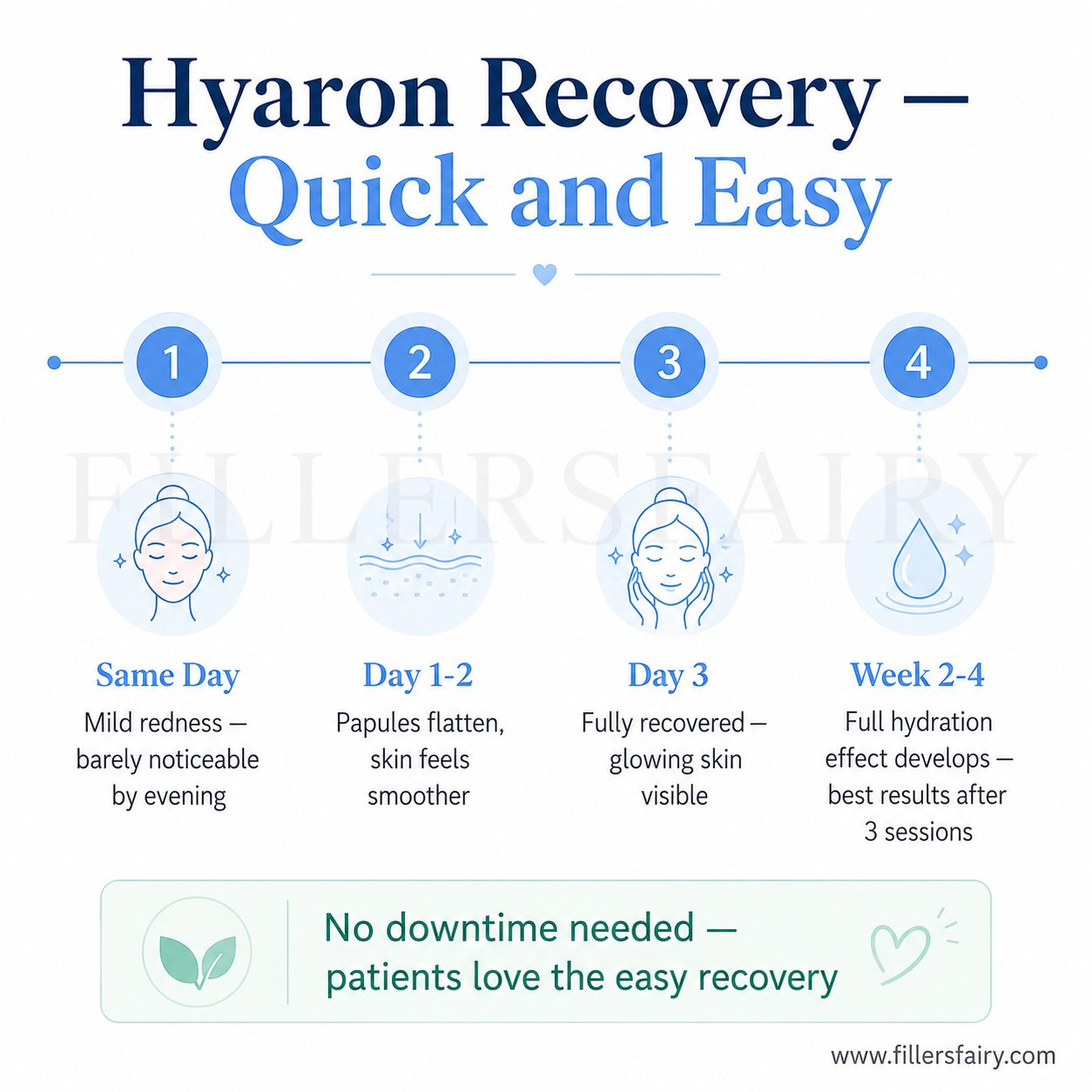
Light redness — fades in 2–6 hours. A normal skin response to micro-injections, similar to how skin turns pink after cleansing or exfoliation. Most patients find it barely noticeable by the time they leave the clinic. Patients with sensitive skin may see mild pinkness for up to 24 hours.
Tiny papules at injection points — gone in 24–48 hours. These small bumps are simply the HA sitting in the skin before it disperses and absorbs. They are temporary and expected — not lumps or nodules. Patients can be reassured that these flatten on their own without any intervention.
Mild puffiness — resolves in 1–3 days. Hyaluronic acid naturally binds water, so a slight plumping effect is part of how the treatment works. Under-eye treatments may show more puffiness because the skin there is thinner. Cold compresses speed resolution, but it resolves naturally even without them.
Occasional minor bruising — 3–5 days if it occurs. Not all patients bruise — it depends on individual vascular anatomy and whether the patient takes blood-thinning medications. When bruising does occur, it is small and easily concealed with makeup after 24 hours.
Bottom line for patients: These reactions are mild, short-lived, and far gentler than what patients experience with dermal fillers or surgical procedures. Most patients describe the recovery as “barely noticeable.”
Rarely Seen Reactions (Uncommon but Easy to Manage)
The following reactions are uncommon with Hyaron. When they do occur, they are typically related to injection technique rather than the product itself and are easily managed.
Puffiness lasting more than 3 days. Unusual with non-crosslinked HA because the body metabolizes it quickly. If it happens, it generally resolves on its own within a few more days. Persistent worsening (getting worse, not better) should be evaluated — but this is rare.
Mild itching. Some patients experience temporary itching at injection sites, which usually resolves within hours. True allergic reactions to non-crosslinked HA are extremely rare because the molecule is identical to what already exists naturally in human skin.
Slight unevenness. If injection distribution was not perfectly uniform, temporary texture differences may be visible. Because Hyaron is non-crosslinked, the HA disperses and evens out on its own within days — unlike fillers where product placement is permanent.
Why Hyaron’s Side Effect Profile Is Milder Than Fillers
Practitioners switching from crosslinked HA fillers to skin boosters like Hyaron often notice that the side effect profile is significantly gentler. This difference comes down to three factors:
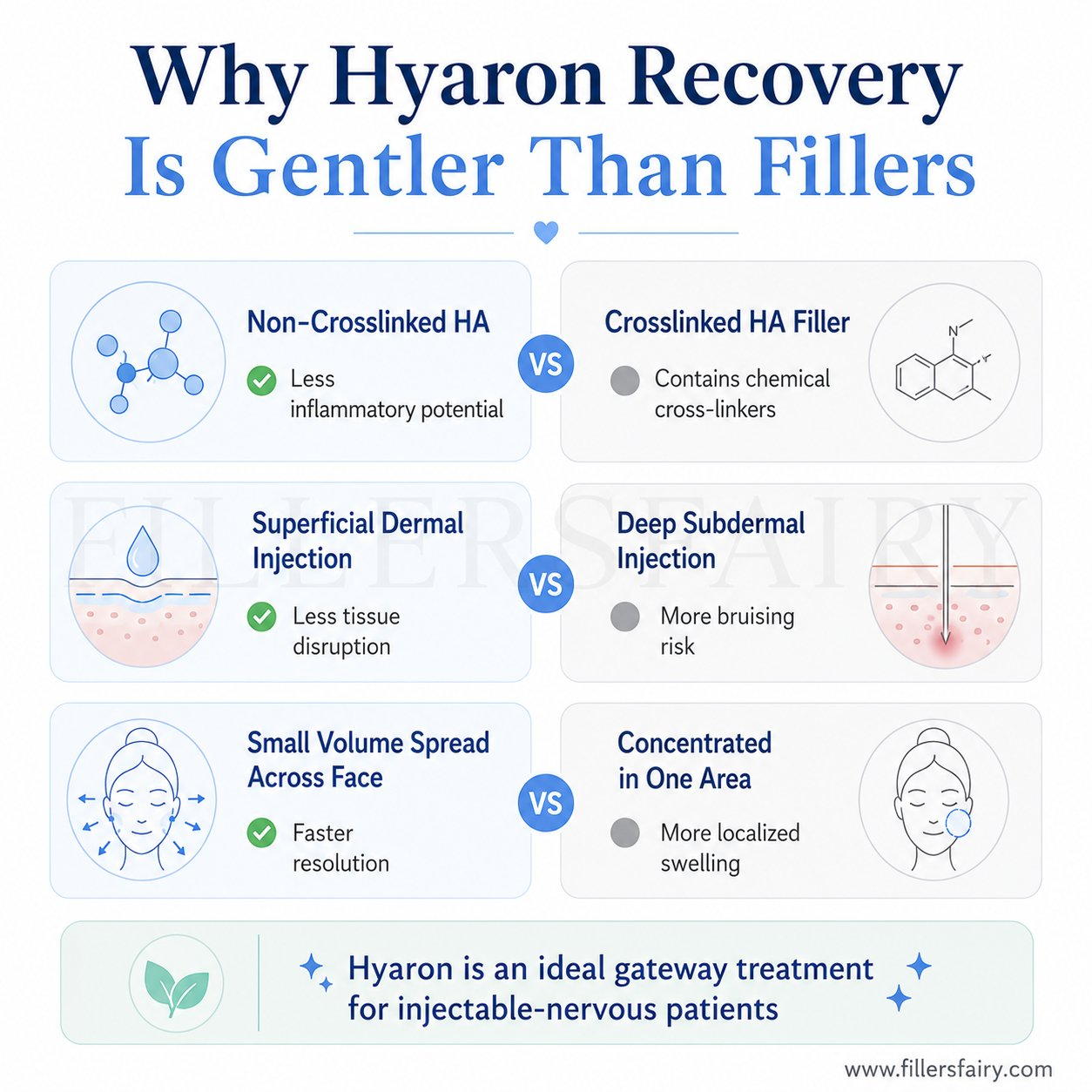
First, Hyaron is non-crosslinked — meaning the HA molecules are not chemically bonded to each other. Without cross-linking agents (like BDDE), there is less foreign material for the body to react to, resulting in lower inflammatory potential.
Second, injection depth is more superficial. Hyaron is placed in the dermis, not the subdermis or supraperiosteal plane. Superficial injections cause less tissue disruption and lower bruising risk than deep filler placement.
Third, the total volume per session is smaller. A typical Hyaron treatment uses 2–3 mL distributed across the entire face, compared to 1–2 mL of filler concentrated in a single area. Smaller per-point volumes mean less tissue distension and faster resolution.
For patients who have had negative experiences with fillers and are hesitant about injectables, Hyaron’s gentler profile makes it an effective re-entry point. This is worth mentioning during patient consultations.
What Patients Love About Hyaron’s Recovery
One of Hyaron’s biggest commercial advantages is its minimal recovery profile. Compared to fillers, botulinum toxin, or laser treatments, patients consistently report that Hyaron recovery is “barely there.” This translates directly into higher patient satisfaction, more positive reviews, and stronger rebooking rates.
The key message for patient consultations: Hyaron is one of the gentlest injectable treatments available. There is no real downtime. Any mild redness or papules resolve within a day or two. Patients can wear makeup after 24 hours, exercise the next day, and return to normal life immediately. For patients who are nervous about injectables or have had uncomfortable experiences with fillers in the past, Hyaron is an ideal entry point — gentle enough to build confidence, effective enough to keep them coming back.
Many clinics use Hyaron as a “gateway treatment” — a low-risk, high-satisfaction first experience that opens the door to more advanced treatments like Rejuran or Curenex Glow down the line.
Simple Post-Treatment Care
Post-treatment instructions for Hyaron are straightforward. Avoid touching or massaging the treated area for 6 hours to allow the HA to settle. No makeup for 12–24 hours to minimize infection risk at injection sites. Avoid intense exercise, saunas, and alcohol for 24 hours — these increase blood flow and can worsen swelling and bruising. Sun protection is advisable for 48 hours as the skin barrier is temporarily compromised at injection points.
Patients can resume normal daily activities immediately. There is no true “downtime” with Hyaron — the common reactions (redness, papules) are cosmetically visible but not functionally limiting. Most patients are comfortable returning to work the same day.
When to Follow Up (Rare — But Good to Know)
The reactions listed above are extremely uncommon with Hyaron. That said, responsible practice means knowing the signs. Advise patients to reach out if they notice:
- Swelling getting worse after 48 hours — should be improving, not increasing
- Fever or warmth at the treatment site — possible infection sign
- Skin color changes — blanching or dusky discoloration may indicate vascular compromise
- Pain increasing rather than decreasing — normal tenderness should fade, not grow
- Widespread hives or difficulty breathing — rare systemic allergic reaction, seek emergency care
These symptoms are rare with non-crosslinked HA but should trigger standard injectable complication protocols immediately when they occur.
Frequently Asked Questions
Why is my skin red after Hyaron?
Redness after Hyaron is completely normal. It happens because the treatment involves multiple small injections into your skin, which triggers a mild inflammatory response. Think of it like how your skin turns red after scratching — it is a natural reaction to stimulation. The redness typically fades within 2–6 hours. If you have sensitive or rosacea-prone skin, it may last up to 24 hours.
Are bumps normal after Hyaron treatment?
Yes. Small raised bumps (papules) at each injection point are expected and completely normal. They are simply the hyaluronic acid sitting in the upper layer of your skin before it spreads and absorbs. These bumps flatten on their own within 24–48 hours. If bumps persist beyond 5 days, contact your practitioner — this is uncommon but may indicate the product was placed too superficially.
How long does swelling last after Hyaron?
Mild swelling usually resolves within 1–3 days. Under-eye treatments tend to swell more than other areas because the skin there is thinner. Applying a cold compress immediately after treatment helps reduce swelling. If swelling is still increasing after 48 hours (rather than decreasing), contact your practitioner for evaluation.
Are Hyaron side effects worse than Rejuran?
Generally comparable. Both involve multiple superficial injections with similar recovery timelines. However, Rejuran (PN-based) tends to produce slightly more noticeable papules because polynucleotide has higher viscosity than non-crosslinked HA. Redness and swelling are similar for both treatments.
Can I wear makeup after Hyaron?
Wait at least 12–24 hours before applying makeup. Your skin has tiny puncture points from the injections, and applying products too soon increases infection risk. After 24 hours, you can resume your normal routine including makeup, skincare, and sunscreen.
Related Guides
- What Is Hyaron? Filler vs Skin Booster Explained — Hub guide
- What Is Rejuran? — PN skin booster comparison
- What Is Curenex Glow? — PDRN skin booster