What Is Juvelook? Why the PDLLA + HA Hybrid Is Replacing Traditional Skin Boosters in Korean Clinics
Last updated: July 2026 · Reading time: 8 min
Quick Answer
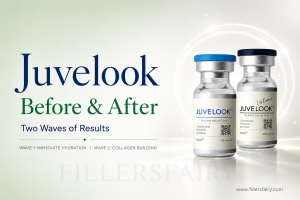
Juvelook is a hybrid collagen stimulator — not a filler, not a traditional skin booster — manufactured by VAIM Inc. (South Korea). It combines PDLLA (Poly-D,L-Lactic Acid) microparticles with non-crosslinked Hyaluronic Acid in a single formulation. The HA delivers immediate hydration; the PDLLA stimulates fibroblasts to produce new collagen and elastin over the following weeks and months. Available in Juvelook 50mg (fine lines, skin quality) and Juvelook Volume (deeper volumising), it is KFDA and CE certified, exported to 60+ countries, and administered as a course of 3 sessions at 1-month intervals with results lasting 6–12 months. Korean practitioners call it the “Liquid Thread” because it achieves lifting and firming effects through collagen stimulation rather than mechanical support.
Why Juvelook Is Not a Filler — And Why That Matters
The most common misconception about Juvelook is that it’s a hyaluronic acid filler. It’s not. Traditional HA fillers add volume mechanically — they sit in the tissue and push it outward. When the HA degrades (6–18 months later), the volume disappears. The skin is unchanged.
Juvelook works the opposite way. The PDLLA microparticles in Juvelook stimulate the skin’s own fibroblasts to produce new collagen and elastin. The HA component provides a temporary hydration effect while the PDLLA initiates a biological repair process. When the HA is absorbed (within weeks), the collagen that the PDLLA stimulated is what makes the result persist.
This distinction matters for practitioners in two ways: First, patient selection is different — Juvelook candidates want skin quality improvement (texture, elasticity, luminosity), not volume augmentation. Second, patient education is different — results are gradual and cumulative, not instant and structural.
How the PDLLA + HA Dual Mechanism Works
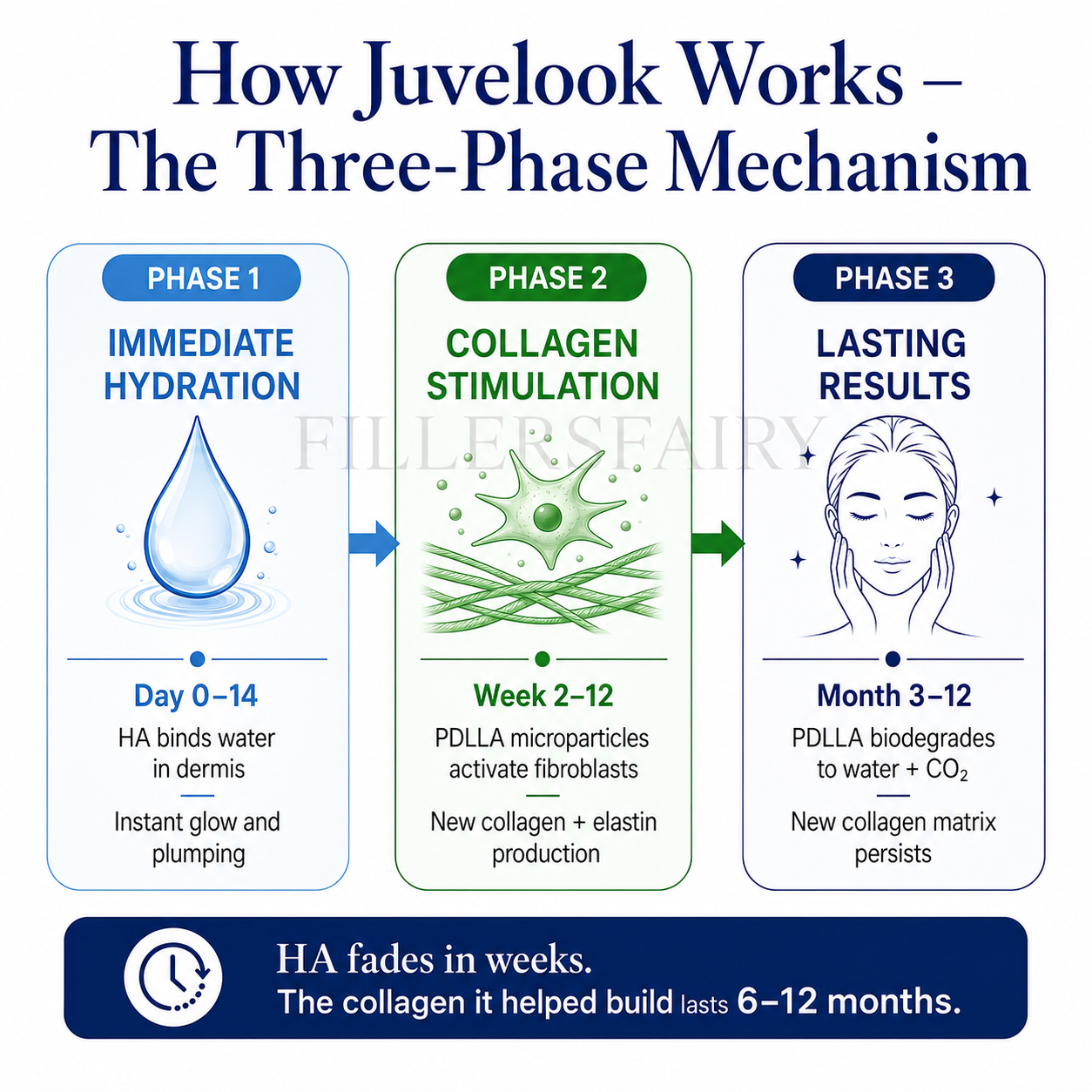
Juvelook’s patented technology works in three phases:
Phase 1: Immediate hydration (Day 0–14). The non-crosslinked hyaluronic acid binds water in the dermis, creating instant plumping and a light glow. This is what patients notice first — their skin looks fresher and more hydrated immediately after treatment.
Phase 2: Collagen stimulation (Week 2–12). As the HA is absorbed, the PDLLA microparticles (10–40 μm, patented porous mesh structure) interact with fibroblasts in the dermis. The porous surface maximises contact area, triggering fibroblast proliferation and the production of new Type I and III collagen plus elastin fibres. A published clinical study (Seo et al.) demonstrated significant improvements in skin elasticity, firmness, and hydration with the PDLLA + non-crosslinked HA combination.
Phase 3: Biodegradation and sustained results (Month 3–12). The PDLLA microparticles gradually biodegrade into water and CO₂ — both naturally metabolised by the body. By the time the PDLLA is fully absorbed, the new collagen matrix it stimulated is in place. Results persist 6–12 months after the treatment course, depending on patient age, skin condition, and lifestyle factors.
Technical Detail: PDLLA vs PLLA — What’s the Difference?
Juvelook uses PDLLA (poly-D,L-lactic acid), not PLLA (poly-L-lactic acid) used in Sculptra. The critical differences: PDLLA has a lower glass transition temperature and hardness, making it more biocompatible. It degrades faster and more evenly into water and CO₂, reducing the risk of nodule formation that has occasionally been associated with PLLA-based products. PDLLA’s amorphous structure (vs PLLA’s semi-crystalline structure) means more uniform degradation without leaving behind crystalline fragments.
Key Specifications
| Parameter | Juvelook |
|---|---|
| Manufacturer | VAIM Inc. (South Korea, founded 2014) |
| Product Category | Hybrid collagen stimulator (not a filler) |
| Active Ingredients | PDLLA (Poly-D,L-Lactic Acid) + non-crosslinked Hyaluronic Acid |
| PDLLA Particle Size | 10–40 μm, patented porous mesh structure (per juvelook.com) |
| Juvelook 50mg | 42.4 mg PDLLA + 7.5 mg HA per vial (per FillersFairy product listing) |
| Juvelook Volume | 200 mg/vial (per product packaging) — larger particles for deeper treatment |
| Treatment Protocol | 3 sessions at 1-month intervals |
| Duration of Results | Juvelook: 6–12 months | Lenisna (VAIM’s premium line): 18–24 months (per juvelook.com) |
| Storage | Room temperature, protect from direct sunlight, do not freeze |
| Reconstitution | Required before injection |
| Regulatory | KFDA (MFDS) + CE certified | Not US FDA approved |
| International Reach | Exported to 60+ countries | FILLMED partnership in Europe |
Juvelook 50mg vs Juvelook Volume — Which One Does Your Clinic Need?
| Feature | Juvelook 50mg | Juvelook Volume (200mg) |
|---|---|---|
| PDLLA Content | 50 mg per vial | 200 mg per vial |
| Particle Size | Smaller (superficial) | Larger (deeper) |
| Injection Depth | Superficial-to-mid dermis | Mid-to-deep dermis |
| Best For | Fine lines, pores, skin texture, periorbital area, acne scars | Volume loss, deep wrinkles, jawline contouring, nasolabial folds |
| Duration | 6–12 months | 12–18 months |
| Patient Profile | Skin quality + texture improvement seekers | Volume + contouring + skin quality combination seekers |
Stocking decision: Most clinics start with the Juvelook 50mg for skin quality treatments (the larger addressable market), then add Volume for patients requesting both skin quality and structural improvement.
How Juvelook Compares to Sculptra, Profhilo, and HA Boosters
| Feature | Juvelook | Sculptra | Profhilo | HA Skin Boosters |
|---|---|---|---|---|
| Active | PDLLA + HA (hybrid) | PLLA | Stabilised HA | Non-crosslinked HA |
| Mechanism | Hydration + collagen stimulation | Collagen stimulation only | Bio-remodelling | Hydration only |
| Immediate Effect | Yes (HA hydration) | No | Mild | Yes |
| Collagen Stimulation | Yes (PDLLA) | Yes (PLLA) | Mild | No |
| Sessions | 3 (monthly) | 3–4 (6-week intervals) | 2 (4-week intervals) | 3–4 (2-4 week intervals) |
| Duration | 6–12 months | 12–24 months | 6 months | 3–6 months |
| Nodule Risk | Lower (PDLLA amorphous) | Higher (PLLA crystalline) | Minimal | Minimal |
Juvelook’s positioning: It sits at the intersection of skin boosters and biostimulators. Unlike HA boosters, it stimulates collagen. Unlike Sculptra, it provides immediate hydration. This dual-action profile is why Korean practitioners adopted it so quickly — it addresses two patient needs in a single treatment.
Treatment Protocol
Standard course: 3 sessions at 1-month intervals. This allows each treatment to build on the collagen stimulation from the previous session.
Reconstitution: Juvelook is a lyophilised powder that requires reconstitution with sterile saline before injection. Follow manufacturer-specified reconstitution protocol. The reconstituted solution should be used within the same session.
Injection technique: Intradermal injection using a 27G–30G needle. Typical delivery methods include serial puncture, nappage, or cannula depending on treatment area and practitioner preference. The 50mg version is suited for superficial placement; Volume is suited for deeper dermal injection.
Post-treatment: Gentle massage of treated areas to distribute the product evenly and minimise nodule risk. Avoid excessive heat, sauna, and intense exercise for 24–48 hours.
Who Is Juvelook For?
The patients who benefit most from Juvelook are those seeking skin quality improvement rather than volume augmentation:
Ideal candidates: Fine lines and early wrinkles, enlarged pores, loss of skin elasticity, dull and dehydrated skin, mild acne scarring, patients who want “glass skin” results, patients seeking natural-looking rejuvenation.
Less suitable: Patients wanting dramatic volumetric change (refer to dermal fillers), patients seeking treatment for deep structural volume loss (consider Juvelook Volume or fillers), patients in the US (Juvelook is not FDA-approved).
Practitioner Confidence Summary
Juvelook is not a filler and not a traditional skin booster — it’s a hybrid collagen stimulator that combines immediate HA hydration with long-term PDLLA-driven collagen production. Manufactured by VAIM Inc. (Korea), KFDA and CE certified, exported to 60+ countries, and backed by published clinical data (Seo et al.). The 50mg version targets skin quality; Volume (200mg) targets deeper volumising. Room-temperature storage simplifies clinic operations. For practitioners looking to add a regenerative treatment that delivers both instant and lasting results, Juvelook fills a category gap that neither HA boosters nor Sculptra can address alone.
Frequently Asked Questions
Is Juvelook a filler?
No. Juvelook is a hybrid collagen stimulator. Unlike fillers that add volume mechanically, Juvelook uses PDLLA microparticles to stimulate the skin’s own collagen production. The HA component provides temporary hydration, not structural volume.
How long do Juvelook results last?
Juvelook 50mg: 6–12 months after completing the 3-session course. Juvelook Volume: 12–18 months. Lenisna (VAIM’s separate premium product line): 18–24 months. Duration depends on patient age, skin condition, and lifestyle factors.
How is Juvelook different from Sculptra?
Both stimulate collagen, but through different polymers. Juvelook uses PDLLA (amorphous, degrades more evenly, lower nodule risk) plus HA for immediate hydration. Sculptra uses PLLA (semi-crystalline, longer-lasting, higher nodule risk) without HA. Juvelook provides immediate visible improvement; Sculptra does not.
Is Juvelook FDA approved?
Juvelook is approved by the Korean MFDS (KFDA) and carries CE certification for European markets. It is not approved by the US FDA. PDLLA as a raw material has a long history of medical use, but the finished product’s regulatory status varies by jurisdiction.
Can Juvelook be stored at room temperature?
Yes. Unlike many injectable aesthetics products that require refrigeration, Juvelook stores at room temperature protected from direct sunlight. Do not freeze. This simplifies inventory management for clinics.