Reviewed against current FillersFairy inventory pages, official Radiesse documents and peer-reviewed product literature. Last source review: July 30, 2026.
Scope: this is a procurement-focused evidence guide for professional clinic teams. It is not an injection protocol, a personal treatment recommendation or a substitute for the exact product label, instructions for use (IFU), regulator record or qualified clinical judgement.
Volassom vs Radiesse at a Glance
| Comparison point | Volassom | Radiesse | Responsible buying conclusion |
|---|---|---|---|
| Material class | CaHA microspheres in a gel carrier, as described by the current FillersFairy listing and the located exact-product study. | CaHA microspheres in a CMC gel carrier, documented in official product information. | Material similarity explains the comparison; it does not establish equivalence. |
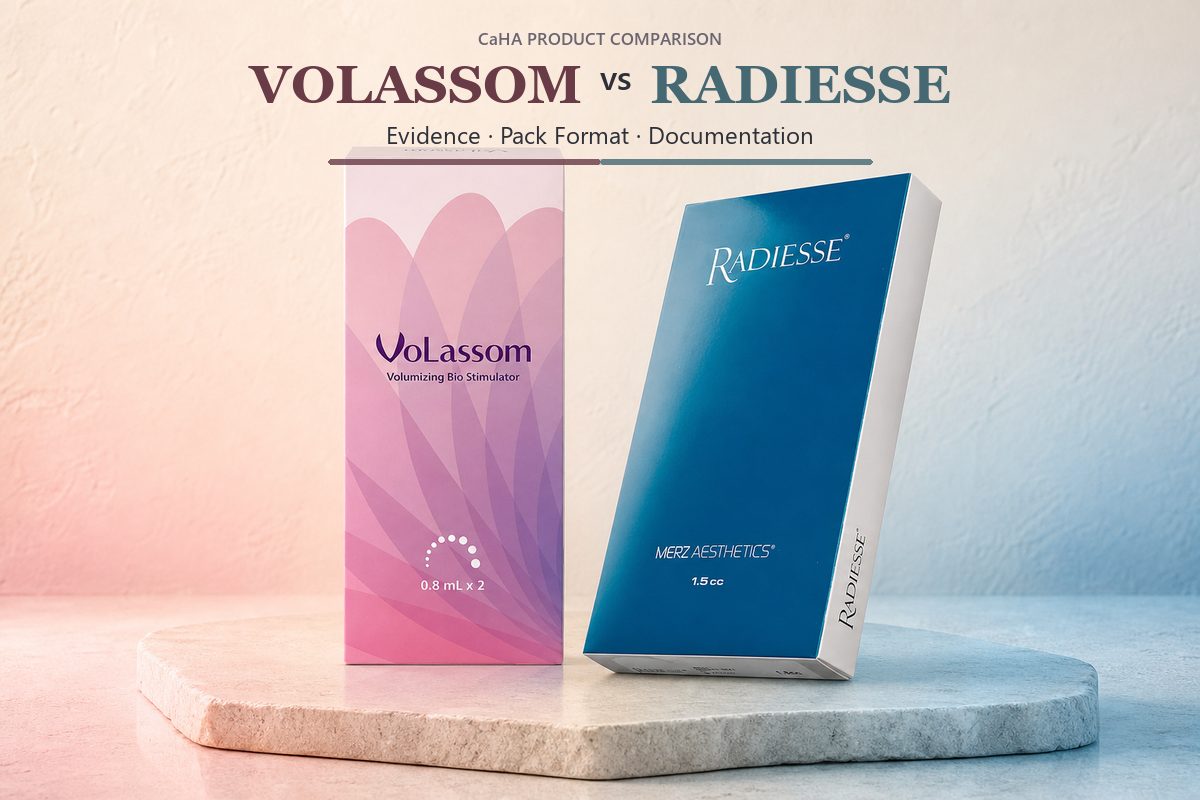
| Current FillersFairy pack | Two 0.8 mL pre-filled syringes per listed box. | One 1.5 mL pre-filled syringe per listed box. | Verify the physical box and documentation because storefront presentations can change. |
| Total listed box volume | 1.6 mL across two syringes. | 1.5 mL in one syringe. | The 0.1 mL box difference is an inventory fact, not a treatment-dose recommendation. |
| Immediate component | The gel carrier is described as providing physical volume while the CaHA-related response develops over time. | Official information describes immediate volume from the gel carrier and later collagen and elastin support. | Shared two-phase language does not prove the same magnitude, handling or duration. |
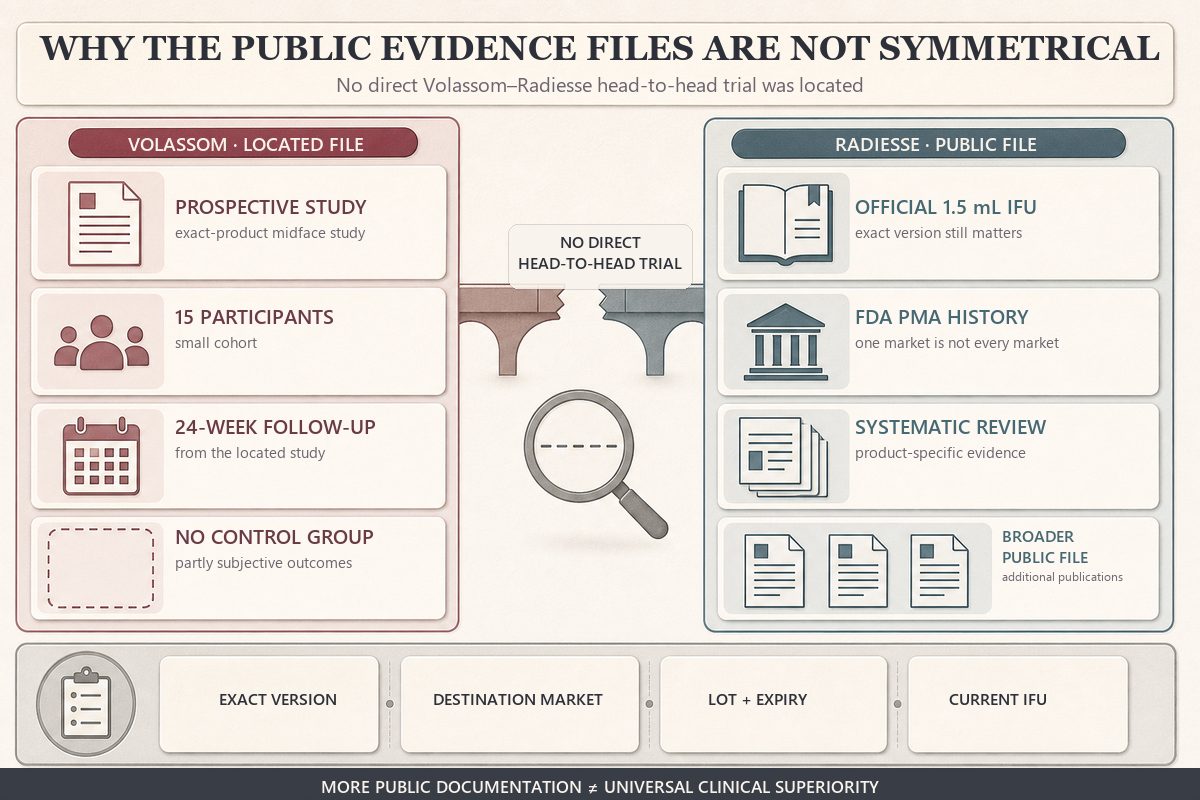
| Located exact-product clinical evidence | One prospective midface study followed 15 participants for 24 weeks. | A broader product-specific literature, official IFUs, regulatory files and systematic reviews are publicly available. | The public evidence stack is asymmetrical, but that alone does not prove universal superiority. |
| Public regulatory-document visibility | This review did not locate a public exact-version IFU or regulator file comparable to the Radiesse set. | Official IFUs and an FDA PMA history are publicly accessible for documented versions. | A documentation gap is not a claim about legal status; request the exact destination-market file. |
| Direct comparison | No Volassom-versus-Radiesse head-to-head clinical trial was located in the primary-source review used for this page. | Do not publish “same,” “dupe,” “better” or “equivalent” as a clinical conclusion. | |
What Both CaHA Products Genuinely Share
Both products sit on the CaHA pathway: mineral microspheres are suspended in a gel carrier, so the early visual component and the later tissue-response discussion should not be collapsed into one claim. The carrier can provide immediate physical support, while research on CaHA materials describes later changes involving collagen, elastin and extracellular-matrix remodelling.
A systematic review of CaHA mechanisms is useful for explaining that broad pattern. It is not evidence that every CaHA product has identical particles, rheology, clinical results or authorised uses. For the wider distinction between CaHA, PLLA, PDLLA and PCL, use the separate collagen stimulators material guide; this page keeps the comparison attached to two exact brands.
The safest interpretation of Volassom vs Radiesse is therefore “same material family, separate product files.” Every statement about indication, accessories, storage, shelf life, preparation, outcome or duration must remain attached to the exact version and jurisdiction that supports it.
Formulation and Sealed Pack Planning
| Inventory question | Volassom listing | Radiesse listing | What to verify |
|---|---|---|---|
| Syringe configuration | 0.8 mL × 2 | 1.5 mL × 1 | Each syringe’s seal, single-use status and included accessories on the exact box. |
| Current listed total | 1.6 mL | 1.5 mL | Do not convert box volume into a generic patient dose or session plan. |
| Composition statement | Current FillersFairy information describes approximately 30% CaHA and 70% CMC-based carrier. | Current official information describes approximately 30% CaHA and 70% CMC gel carrier. | Exact ingredients, buffers and lidocaine presentation in the applicable IFU. |
| Operational record | The product name alone is not enough for receiving, storage or use. | Lot, expiry, legal manufacturer, market authorisation, IFU revision, storage and traceability. | |
Two smaller syringes and one larger syringe create different sealed-unit questions for stock control, but the configuration should not be turned into an assumed clinical advantage. A buyer must first confirm how the syringes are individually sealed, what accessories are supplied, whether the exact version contains lidocaine, and which IFU applies. Current storefront data helps identify the SKU; it does not replace the pack record.
Price is deliberately excluded from this evergreen comparison. Product price, freight, currency, quantity tier and availability can change. For a Volassom vs Radiesse stock review, the durable comparison is the documented sealed presentation and the evidence attached to it.
The Product-Specific Evidence Is Not Symmetrical
| Evidence question | Volassom file used here | Radiesse file used here | Interpretation boundary |
|---|---|---|---|
| Exact-product study | Prospective 24-week midface study. | Multiple product-specific studies are synthesised in a systematic review of Radiesse/CaHA-CMC. | Different study bodies cannot be converted into a direct winner without a head-to-head design. |
| Located study design | 15 participants, one treating dermatologist, no control group and follow-up at 2, 4 and 24 weeks. | Evidence spans different indications, designs, follow-up periods and product versions. | Read each outcome only within its studied population, product and time window. |
| Important limitations | Small cohort, no comparator, partly subjective scales, wide age range and no evidence beyond 24 weeks from that study. | The systematic review reports uneven evidence by facial indication and no randomised trials for diluted or hyperdiluted use at publication. | “Published” does not mean every commercial or clinical claim is proven. |
| Transparency notes | The paper reports a CGBio consultant relationship and funding that includes CGBio. It also says 15 participants in the abstract, methods and results, while one limitations sentence says n = 16. | Manufacturer, regulator and publication sources each have different purposes and must be labelled accordingly. | Disclosures and internal reporting inconsistencies are reasons for caution, not reasons to erase the study. |
| Formal product documentation | Request the exact destination-market IFU and authorisation file from the supply chain. | Official 1.5 mL IFU, current US information and FDA PMA history are publicly accessible. | One country’s record does not authorise a product in every destination market. |
The located Volassom paper reports improvements in midface volume measures and instrument-based skin measures through 24 weeks, with no serious adverse events observed in its small cohort. It studied undiluted product in a defined midface protocol. This page does not turn that research protocol into general dosing or technique advice.
In the Volassom vs Radiesse evidence set used here, Radiesse has a larger and more visible product-specific documentation history. The exact version still matters: Radiesse, Radiesse (+), different syringe volumes and market-specific IFUs are not one interchangeable file. The evidence advantage is best described as greater public documentation depth, not proof that Radiesse is the best choice for every patient, clinic or market.
No Head-to-Head Trial Means No Universal Winner
Shortcut: “Both are 30% CaHA, so they should perform the same.”
Evidence answer: concentration and material class do not describe every particle, carrier, manufacturing control, rheological property, product version or clinical file.
Shortcut: “Volassom is a Radiesse dupe,” or “Radiesse is automatically better.”
Evidence answer: neither statement was supported by a direct comparative clinical trial in the reviewed source set.
A useful Volassom vs Radiesse page should therefore help a buyer identify what is known, what comes from a material review, what belongs to one exact product, and what remains unproven. It should not manufacture a winner from brand familiarity, box price or a shared ingredient percentage.
Documentation Checklist Before a Clinic Stock Decision
- Exact product and version: record the full trade name, syringe volume, lidocaine presentation if any, reference number and IFU revision.
- Legal manufacturer on the pack: use the sealed label and formal document, not an unsourced marketplace description or copied product image.
- Destination-market eligibility: verify the applicable regulator record, authorised importer or distributor requirements, and professional-use restrictions.
- Sealed presentation: confirm syringe count, fill volume, accessories, tamper evidence and whether each unit is individually sterile and single use.
- Traceability: check lot, expiry, UDI or equivalent identifiers, and retain purchasing and receiving records.
- Storage and transport: follow the exact label for temperature, light, freezing and transport conditions; do not infer one brand’s rules from the other.
- Clinical file: keep the exact IFU, contraindications, warnings and complication pathway available to the qualified team before the product enters the service menu.
In a Volassom vs Radiesse procurement check, the current FillersFairy listings provide the stock presentation that starts the commercial review. They do not replace formal product documentation. If the exact version, market status or traceability cannot be verified, the responsible decision is to pause the order rather than fill the gap with a generic CaHA assumption.
Which CaHA Route Should a Clinic Investigate First?
| Clinic requirement | First route to investigate | Reason | Stop condition |
|---|---|---|---|
| A mature, readily accessible formal evidence and regulatory stack is the first procurement filter. | Investigate the exact Radiesse version. | Official IFUs, FDA history and a broader product-specific literature can be reviewed before ordering. | The available version or intended use is not documented for the destination market. |
| The clinic specifically wants to evaluate the current Korean two-syringe CaHA presentation. | Investigate the exact Volassom pack. | The listed 0.8 mL × 2 configuration and located 24-week study create a defined starting file. | The exact IFU, legal manufacturer, traceability or market eligibility cannot be supplied. |
| The team wants a generic “cheaper Radiesse” or an assumed interchangeable product. | Neither. | The premise exceeds the current comparative evidence. | Reframe the decision around exact documents, clinical role and qualified professional capability. |
After this exact comparison, the Biostimulatory Fillers Guide can help a clinic compare broader product roles. Keep the two decisions separate: D5 answers which exact CaHA file deserves further investigation; the hub answers how different products may fit a wider inventory.
Limits, Reversibility and Safety
Neither product should be treated like an HA-only filler that can be enzymatically dissolved with hyaluronidase. The carrier and CaHA microspheres are not made fully reversible by that enzyme. This makes exact product selection, conservative professional planning and complication readiness important before use.
Expected local reactions described for injectable fillers can include swelling, redness, tenderness, bruising, itching or lumps. Rare vascular injection can cause embolisation, vessel occlusion, ischaemia, infarction, visual injury or other serious harm. Product selection and administration belong to appropriately trained, licensed healthcare professionals who have read the exact IFU and can recognise and manage complications. This comparison intentionally provides no injection depth, dose, dilution method, technique or session schedule.
Frequently Asked Questions
Are Volassom and Radiesse the same product?
No. Both are CaHA microsphere injectables with a gel carrier, but they are separate commercial products with different listed pack formats and different product-specific documentation. A shared material class does not prove identical particles, handling, indications, clinical outcomes or duration. The exact label and IFU should decide product-specific claims.
Is Volassom better than Radiesse?
No universal winner can be supported from the reviewed evidence. No direct Volassom-versus-Radiesse clinical trial was located. Radiesse has a broader public regulatory and clinical file, while Volassom has a located prospective 24-week study and a different listed syringe configuration. The relevant choice still depends on the exact market and clinical role.
Which product has more clinical evidence?
Radiesse has the larger publicly accessible product-specific evidence and regulatory history in the source set used here. Volassom has a prospective 24-week midface study involving 15 participants. Evidence volume alone does not prove that one product is clinically superior for every use. Study quality and applicability matter as much as publication count.
Can Volassom or Radiesse be dissolved with hyaluronidase?
No. Hyaluronidase is used for hyaluronic-acid material; it does not enzymatically dissolve CaHA microspheres or make either product fully reversible. Clinics need the exact IFU, appropriate professional training and a complication pathway before stocking or using a CaHA injectable. Any complication requires immediate assessment under an established clinical pathway.
What documents should a clinic check before ordering either product?
Check the exact product name and version, legal manufacturer, destination-market authorisation, current IFU, syringe and box configuration, lot, expiry, traceability identifiers, storage requirements and supplier authenticity. If these records cannot be matched to the physical pack, pause the order. Storefront text alone is not enough for procurement clearance.
Continue the Product Investigation
Use the protected Volassom evidence guide for the wider product explanation, then compare the current Volassom 0.8 mL × 2 listing and Radiesse 1 × 1.5 mL listing. Confirm the exact destination-market documents and sealed presentation before treating either listing as order-ready.
Bottom line: the responsible answer to Volassom vs Radiesse is not a one-word winner. It is a documented choice between two exact CaHA products whose pack configurations, public evidence depth and market files must be verified separately.