What Is Hyaron? Non-Crosslinked HA Skin Booster Guide (2026)
A practitioner’s reference to Hyaron — the pure non-crosslinked HA skin booster with nearly four decades of clinical history, designed for high-frequency hydration protocols.
Quick Answer
What is Hyaron? Hyaron is an injectable non-crosslinked sodium hyaluronate skin booster manufactured by DongKook Pharmaceutical Co., Ltd. (South Korea). Each prefilled syringe contains 25 mg of sodium hyaluronate in 2.5 mL (concentration: 10 mg/mL), fitted with a 30G needle. Packaged 10 syringes per box. Originally launched in 1987 for intra-articular knee osteoarthritis treatment, Hyaron was later adopted as an aesthetic skin booster for dermal hydration and texture improvement. MFDS-approved, 36-month shelf life, store at 1–30°C.
Why Clinics Choose Hyaron
Hyaron is the workhorse of the Korean skin booster market. It does one thing — deep dermal hydration — and it does it reliably, affordably, and at scale.
- Nearly four decades of clinical data — launched in 1987, Hyaron has the longest continuous market presence of any Korean skin booster. Its safety profile is established across both orthopedic and aesthetic applications.
- Pure non-crosslinked HA — no added actives, no reconstitution. Ready to inject from the syringe. This eliminates preparation error and keeps protocols fast.
- 10 syringes per box — the highest syringe count per package among Korean skin boosters. This lowers the per-treatment cost and makes high-frequency protocols economically viable.
- Mesotherapy-compatible workflow — Hyaron fits directly into existing mesotherapy routines. If your team already runs meso protocols, adding Hyaron requires minimal training adjustment.
- Room-temperature storage — 1–30°C, no refrigeration required. Dramatically simplifies inventory and logistics compared to cold-chain-dependent products.
- Combination-friendly — its simple HA-only formulation means Hyaron layers safely with PN skin boosters like Rejuran, toxins, and energy-based devices without ingredient interaction concerns.
For a broader view of how non-crosslinked HA technology fits alongside PN, exosome, and PDLLA boosters, see our Korean Skin Boosters Guide.
How Hyaron Works

In Simple Terms
Hyaron delivers non-crosslinked hyaluronic acid directly into the dermis. Each HA molecule binds up to 1,000 times its weight in water, creating an immediate hydration reservoir beneath the skin surface. Over repeated sessions, this sustained hydration improves skin elasticity, texture, and radiance — not by adding volume, but by restoring the extracellular matrix environment that healthy skin needs.
Technical Details — Full Mechanism ▸
Immediate phase (0–72 hours): Non-crosslinked sodium hyaluronate (MW typically 1–2 million Da) integrates into the dermal extracellular matrix. High-molecular-weight HA acts as a humectant, binding water and creating osmotic pressure that plumps dermal tissue. Unlike crosslinked HA fillers, non-crosslinked HA does not form a discrete gel bolus — it distributes evenly across the injection plane.
Short-term phase (1–4 weeks): Endogenous hyaluronidase gradually breaks down the injected HA into lower-molecular-weight fragments. These fragments are not inert — they participate in cell signaling, interacting with CD44 and RHAMM receptors on fibroblasts and keratinocytes, supporting cellular turnover and wound healing processes.
Cumulative phase (multiple sessions): Serial injections every 10–14 days create a compounding hydration effect. Each session replenishes the HA reservoir before the previous dose is fully metabolized. After 4–10 sessions, patients typically show measurable improvements in skin hydration (corneometry), elasticity (cutometry), and transepidermal water loss (TEWL) that persist beyond the treatment course.
Key distinction from fillers: Non-crosslinked HA is metabolized within 2–4 weeks (vs. 6–18 months for crosslinked HA fillers). It does not add volume, lift, or reshape. It conditions the skin’s matrix for better moisture retention and improved barrier function.
Hyaron vs. Crosslinked HA Fillers

One of the most common questions from practitioners new to skin boosters — particularly relevant given Hyaron’s HA-based formulation. If you already know this, our detailed breakdown is here. The quick version:
| Parameter | Hyaron (Skin Booster) | Crosslinked HA Filler |
|---|---|---|
| HA Type | Non-crosslinked (free-flowing) | Crosslinked (gel matrix) |
| Concentration | 10 mg/mL | 20–24 mg/mL (typical) |
| Primary Purpose | Hydration, texture, glow | Volume, lift, contouring |
| Injection Depth | Superficial–mid dermis | Deep dermis–subcutis |
| Duration per Dose | 2–4 weeks | 6–18 months |
| Volume Effect | None | Yes — structural |
| Protocol | Serial sessions (4–10) | Single session, touch-up |
| Needle | 30G (fine, superficial) | 27G or cannula |
The distinction matters for patient communication. Patients expecting filler-like volume from Hyaron will be disappointed. Patients seeking skin quality improvement — “my skin just looks tired” — are the ideal candidates.
Treatment Areas
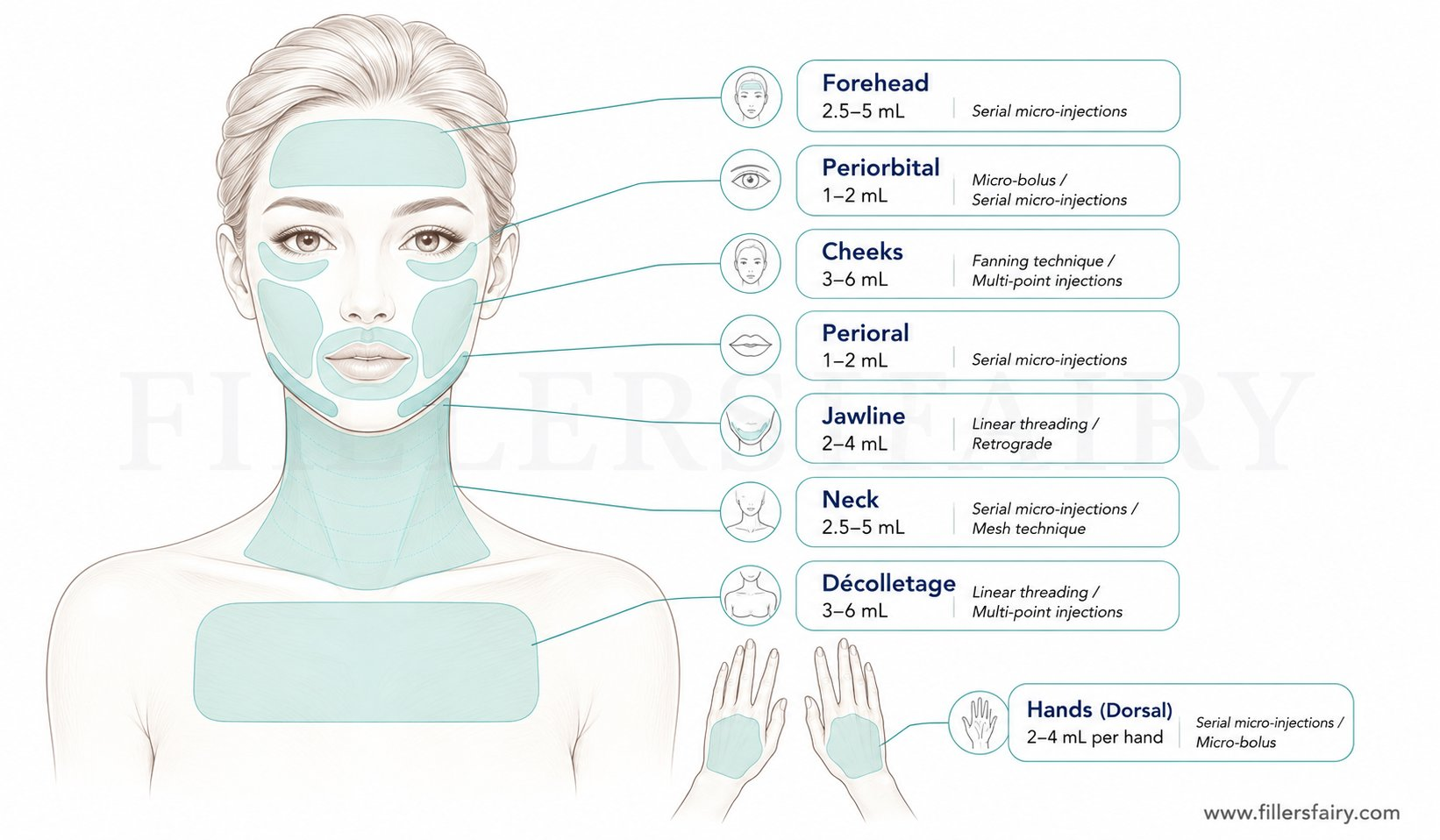
Hyaron’s non-crosslinked formulation and fine 30G needle make it suitable for virtually all mesotherapy-accessible areas:
| Area | Typical Volume | Technique | Clinical Notes |
|---|---|---|---|
| Full face | 2.5–5 mL (1–2 syringes) | Serial micro-injections or nappage | Most common presentation — overall hydration and glow |
| Forehead | 1–1.5 mL | Superficial papular technique | Thin skin — go shallow, even distribution |
| Periorbital | 0.5–1 mL per side | Very superficial, micro-droplets | Caution: thin skin, visible papules if injected too deep. Use lowest volume per point. |
| Cheeks | 1.5–2.5 mL per side | Grid pattern or nappage | Most forgiving area — even distribution, natural spacing |
| Perioral | 1–1.5 mL | Fine papular injection | Effective for smoker’s lines and lip border hydration |
| Neck | 2.5–5 mL | Nappage or micro-injection grid | High demand area — aging neck skin responds well to HA hydration |
| Décolletage | 5–7.5 mL | Wide-area nappage | Larger treatment area — plan 2–3 syringes per session |
| Hands | 2.5 mL per hand | Micro-injection between metacarpals | Dorsal hand rejuvenation — visible skin quality improvement |
Is Hyaron Right for Your Patients?
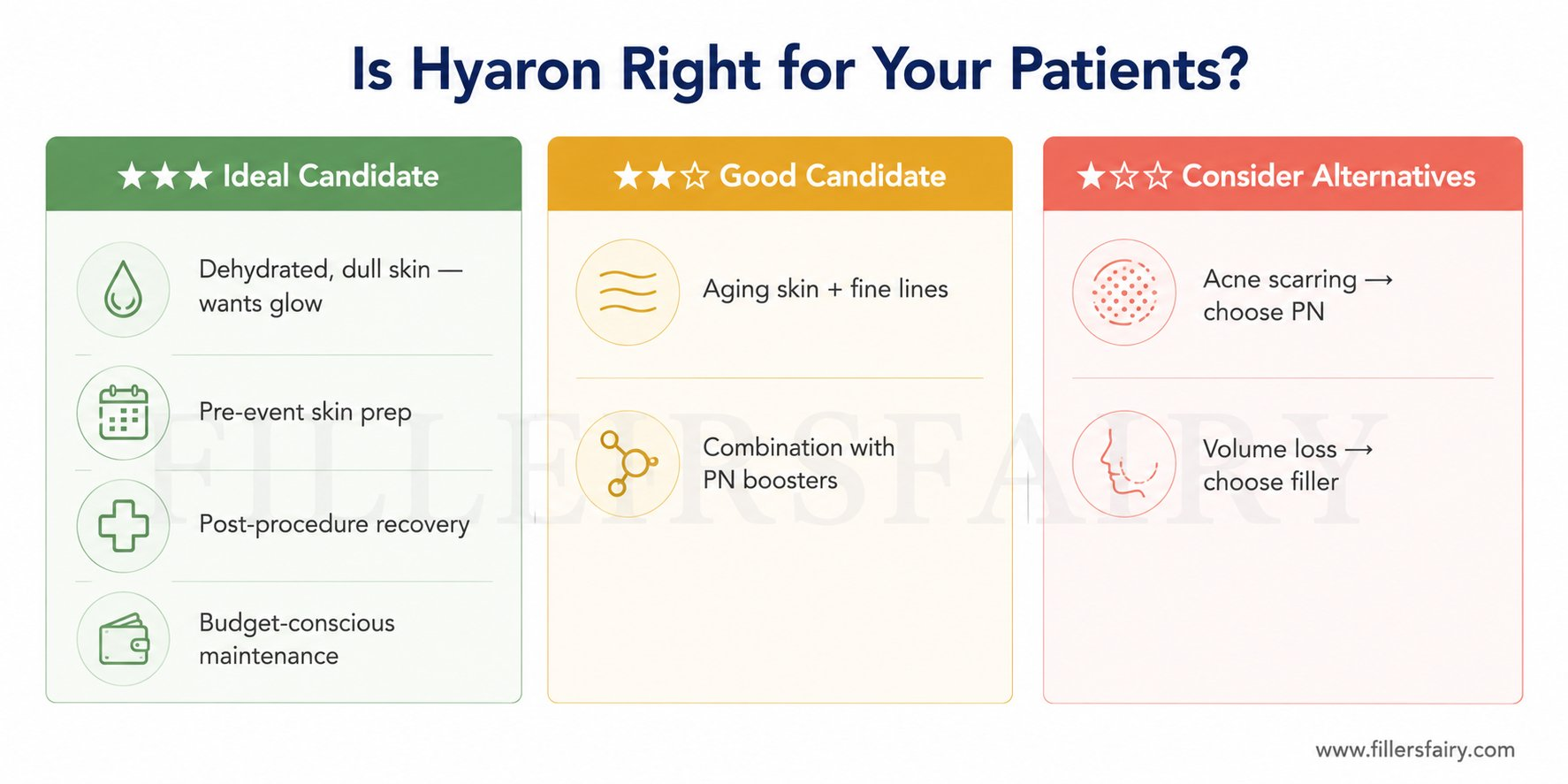
| Patient Profile | Hyaron Fit | Reasoning |
|---|---|---|
| Dehydrated, dull skin — wants “glow” | ★★★ Ideal | Core indication. HA hydration directly addresses this. |
| Pre-event skin prep (wedding, photoshoot) | ★★★ Ideal | Rapid onset, visible improvement within 24–48 hrs, no downtime. |
| Post-procedure recovery (laser, peel) | ★★★ Ideal | HA supports barrier recovery and hydration after ablative procedures. |
| Aging skin with fine lines + dryness | ★★☆ Good | Hydration improves fine lines. Deep wrinkles need fillers. Consider combination with Rejuran for collagen repair. |
| Acne scarring or texture issues | ★☆☆ Limited | HA hydration helps but doesn’t address scar remodeling. PN/PDRN products (Rejuran) are better suited. |
| Volume loss, facial contouring needs | ☆☆☆ Not appropriate | Hyaron is not a filler. Refer to crosslinked HA or biostimulatory fillers. |
| Budget-conscious patients wanting ongoing skin maintenance | ★★★ Ideal | 10 syringes per box makes Hyaron one of the most cost-effective boosters for serial protocols. |
Procedure, Recovery, Results
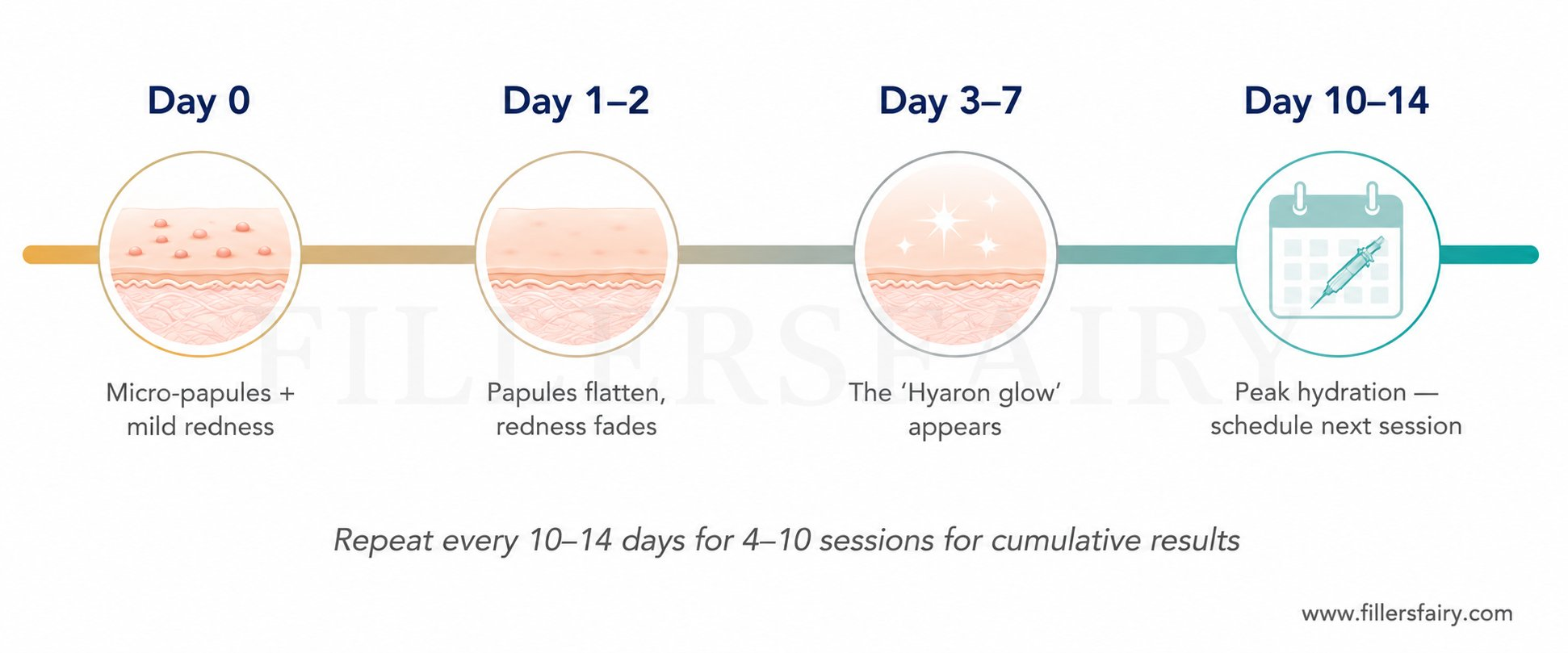
Treatment Protocol
| Parameter | Detail |
|---|---|
| Sessions per course | 4–10 sessions |
| Session interval | Every 10–14 days |
| Volume per session | 2.5–7.5 mL (1–3 syringes) depending on treatment area |
| Needle | 30G (included, prefilled) |
| Anesthesia | Topical numbing cream optional (30G is well-tolerated) |
| Session duration | 15–30 minutes (face) |
| Maintenance | Monthly single-session top-ups or repeat course every 3–6 months |
Recovery Timeline
Day 0 (treatment day): Mild redness and micro-papules at injection sites. These are normal and expected with any mesotherapy-style injection. Patients can resume normal activities immediately — no downtime.
Day 1–2: Papules flatten. Redness resolves. Some patients notice hydration improvement within 24 hours. No makeup for the first 12 hours post-treatment.
Day 3–7: Skin begins to look plumper and more radiant. The “Hyaron glow” — a hallmark of non-crosslinked HA boosters — is typically visible by day 3–5.
Day 10–14: Hydration effect is at its peak. This is the optimal window for the next session — replenish the HA reservoir before it’s fully metabolized.
Results Timeline
Patients should understand that Hyaron is a cumulative treatment, not a one-shot transformation. Individual session results (immediate hydration, glow) are visible but temporary. The compounding effect across 4–10 sessions is where the real clinical value lies — improved skin elasticity, reduced transepidermal water loss, and lasting texture improvement that extends beyond the active treatment course.
Side Effects and Safety
Hyaron has one of the most established safety profiles in the aesthetic injectable category, with nearly four decades of clinical use across both orthopedic and dermatological applications.
Common (Expected, Self-Resolving)
- Injection-site papules — small bumps at each injection point. Resolve within 24–72 hours. Not a complication — a feature of mesotherapy technique.
- Mild redness and erythema — resolves within hours to 1 day.
- Mild swelling — especially in thin-skin areas (periorbital, forehead). Resolves within 24–48 hours.
Uncommon
- Bruising — technique-dependent. More common in patients on anticoagulants. Standard bruising management applies.
- Transient itching — rare, self-resolving.
Safety Advantages
Non-crosslinked HA carries significantly lower risk than crosslinked HA fillers because it does not form persistent gel deposits. There is no risk of vascular occlusion (the most serious filler complication), no granuloma formation, and no late-onset nodule risk. If overcorrection occurs — visible papules that do not resolve — endogenous hyaluronidase will break down the HA within days. The product is also bioidentical to native human HA, making allergic reactions exceptionally rare.
Contraindications
- Known hypersensitivity to hyaluronic acid (extremely rare)
- Active skin infection or inflammation at the treatment site
- Autoimmune skin conditions in active flare
- Pregnancy and breastfeeding (standard precaution — no evidence of harm, but no controlled studies)
Frequently Asked Questions
Is Hyaron a filler or a skin booster?
Hyaron is a skin booster, not a filler. It uses non-crosslinked hyaluronic acid that hydrates and conditions the skin without adding volume. For a detailed explanation of the difference, see our guide: Is Hyaron a Filler or Skin Booster?
How many Hyaron sessions are needed for visible results?
Most patients see noticeable hydration improvement after 2–3 sessions. A full course is 4–10 sessions spaced every 10–14 days. The cumulative effect is the primary clinical value — single sessions provide temporary hydration, serial treatment builds lasting skin quality improvement.
Can Hyaron be combined with Rejuran or other PN skin boosters?
Yes. Hyaron (HA hydration) and Rejuran (PN tissue repair) address different mechanisms and layer well together. Common protocols either alternate sessions or inject both in the same session at different depths. The combination delivers both immediate hydration and long-term collagen repair.
How does Hyaron compare to other HA skin boosters?
Hyaron’s differentiator is its simplicity and value proposition: pure non-crosslinked HA at 10 mg/mL, 10 prefilled syringes per box, room-temperature storage, no reconstitution. Premium HA boosters like Profhilo (crosslinked + non-crosslinked blend, 64 mg/2 mL) target a different clinical outcome (tissue remodeling via bio-remodeling). For a technology-level comparison, see our Korean Skin Boosters Guide.
What needle size does Hyaron use?
Hyaron comes with a 30G needle pre-attached to each syringe. 30G is optimal for superficial-to-mid dermal mesotherapy — fine enough to minimize papule size and patient discomfort, while maintaining adequate flow for the low-viscosity non-crosslinked HA formulation.
Does Hyaron need refrigeration?
No. Hyaron stores at 1–30°C — room temperature is fine. This is a significant logistical advantage over PN/PDRN products that typically require 2–8°C refrigeration. Shelf life is 36 months from manufacture.
This article is part of FillersFairy’s Korean skin booster encyclopedia. Browse our skin booster collection for specifications, variant details, and wholesale pricing.